Showing posts with label food culture. Show all posts

Tuesday, July 21, 2015

I too Sing America

I thought about this post a little before the 4th of July and around the time of the murders in South Carolina. At that time writing about food seemed trivial. After all, what did I have to say? What could I contribute?

What I really wanted was to go to bed and cry. But if there was any chance that I could help, I needed to pull everything together and go back into the world.

I am a daughter of sharecroppers and descendant of slaves. That does not make me special, but it does mean that I may not see the world as others. We are apart of the fabric of this country. Our blood has spilled to protect it.

As a nation, we seem to have lost our ability to sit together and discuss our commonalities and our differences. We don't always need to agree, but we do need to listen and respect different viewpoints.

This week, I am offering a recipe and a seat at the table of brotherhood. For as Langston Hughes, wrote, I, too Sing America.

This is a recipe for Crunchy Roast Chickpeas with Za'atar.

Za'atar is a Middle Eastern flavoring blend consisting of dried thyme, marjoram or oregano, sumac and toasted sesame seeds. One of my students told me that typically, bread is dipped in olive oil and then in za'atar. Similarly to the way Italians dip bread. She also told me that everyone makes za'atar differently and the good stuff is made at home. Since I have no idea how za'atar is supposed to taste, I headed to my local Middle Eastern store and purchased some.

Crunchy Roast Chickpeas with Za'atar

Ingredients:

1 can (15 ounces) chickpeas (garbanzo beans)
2 Tablespoons olive oil
1 Tablespoon za'atar

Directions:

1. Drain and rinse chickpeas. Spread on paper towels to dry. This should take about an hour or so.

2. Preheat oven to 400°F. Place chickpeas on a rimmed baking sheet. (Note - I used my cast iron skillet and it worked just fine.)

3. Bake at 400°F for about 30 minutes, stirring every 10 minutes. Coat with olive oil. Sprinkle za'atar over chickpeas. Place in a serving dish and eat as an appetizer.

4. Chickpeas should be crunchy on the outside and soft on the inside.


I liked za'atar, although I did find it to be a rather mild seasoning. I think next time, I will try it on peanuts. You can take the girl out of the south, but you can't take the south out of the girl.

This recipe is from the blog, "Rose Water & Orange Blossoms" by Maureen Abood. It is a wonderful site. Please check it out.

Monday, March 9, 2015

Not Your Mother's Spice Rack

One of my colleagues told me her father stated that good food did not need spices. Interesting.

My grandmother, on the other hand, told me that poor food would kill me. In other words, spice it up. Now mind you, grandma did not have a lot of spices, salt, pepper, cinnamon, allspice, nutmeg, cayenne pepper and a few others.

Fast forward and I have a cabinet full of spices. I took grandma's advice to heart. While I will always use cinnamon, I also have coriander, cumin, Aleppo pepper, black peppercorns, chipotle pepper, and the list continues. I like to experiment with spices and other food cultures.


And this is only part of the collection!
 
It seems that more Americans are joining me in my quest for a wider variety of spices. We don't want just more spices, we also want more spice blends. Standing along side the standard Italian and poultry seasonings are ras el hanout, a spice used North African cooking, especially Morroco, harissa another North African spice, Indian inspired curry powder, and za'tar from the middle east. Needless to say, the list continues. Americans are on a spice roll. And I say we are the better for it. It is always wonderful to experience the food of another culture.

For this post, I am going with ras el hanout, a Moroccan spice mixture. You can purchase ras el hanout or make your own. Ras el hanout loosely translates to "head of the shop" and refers to the best spices the shop has to offer. Each shop has its own blend, but typically contain cardamom, clove, cinnamon, coriander, cumin, paprika, mace, nutmeg, peppercorns, and turmeric.

Ras el hanout is flavorful, but not hot. Since it is a spice blend, it can be used in marinades, as a rub, stews and braises. Check out The Kitchn for ways to use ras el hanout and other spice blends.


Ras el Hanout

Makes about 2 tablespoons.
 
Ingredients:

1 teaspoon ground cumin
1 teaspoon ground ginger
1 teaspoon salt
¾ teaspoon black pepper
½ teaspoon ground cinnamon
½ teaspoon ground coriander
½ teaspoon cayenne
½ teaspoon ground allspice
¼ teaspoon ground cloves
 
Directions:

Whisk together in a small bowl until well combined. Mixture can be stored in a jar at room temperature for several weeks.
 
I have used this mixture on chicken and fish.  Both are equally good.

Wednesday, February 11, 2015

Brussels sprouts...Little Cabbages

Little cabbages - that's what I used to call Brussels sprouts. To my child's eyes that is what they looked like. To my adult eyes, that is still what they look like.  Brussels sprouts and cabbages are different plants, but part of the same family. Guess I wasn't too far off.

Until recently, Brussels sprouts were not readily seen. Maybe only grandma was eating them. Lately, they are everywhere. The internet has tons of recipes for Brussels sprouts. You would think we discovered Brussels sprouts.

Brussels sprouts are believed to have been cultivated in Italy during Roman times.  Brussels sprouts that we are familiar with were first cultivated in Belgium as early as 1587 and were introduced in the US in the 1800s. Okay, so we didn't discover Brussels sprouts, but we can still enjoy them.

I like Brussels sprouts. (If you like them, it's okay. You can admit it.) My love of Brussels sprouts has me looking for new recipes. For this posting, I found recipe on the California Almond Board and changed it to make it more Midwestern. Below is my version. But please feel free to try the recipe as the almond board intended it. My goal is that everyone eats good food. Use a recipe as a starting point. Changing it to fit your taste is perfectly fine.
 
Brussels sprouts Salad

Serves 8.
 
Ingredients:
12 ounces Brussels sprouts
½ cup slivered almonds
1 large firm pear
¼ cup finely chopped red onion
½ cup seedless red grapes, halved
cup dried cranberries

Dressing:
2 Tablespoons extra virgin olive oil
3 Tablespoons apple cider vinegar
1½ Tablespoons sugar
½ teaspoon salt
¼ teaspoon red pepper flakes

Directions:

1. Wash Brussels sprouts. Remove damaged outer leaves. Slice Brussels sprouts very thinly. Set aside.

2. Toast almonds in a 300°F oven for about 10 minutes or until lightly browned. Set aside.

3. Wash and chop the pear. In a large bowl, combine pear, onion, and grapes. Set aside.

4. In a large saucepan, bring about 4 cups of water to a boil. Add ½ teaspoon salt. Add Brussels sprouts and cook for about 2 minutes. Add cranberries during the last 30 seconds. Drain. Add cold water to cool. Drain thoroughly. Add to pear mixture along with the almonds.

5. In a separate bowl, combine dressing ingredients. Pour over Brussels sprouts. Stir to combine.

Wednesday, July 23, 2014

You Asked for It!

Recently I posted this beautiful picture (if I must say so myself) on Facebook. Immediately, I got 'likes' and people wanted the recipe. Music to a foodie's ears. To all of my Facebook friends who 'liked' it and asked for a recipe, thank you and here's the recipe.


First of all, this is a recipe for chermoula (no we can't pronounce it either). Chermoula is a sauce of North African origins. After making it, I was reminded of a pesto, but with more oil. According to my resources, it is a marinade, or used to rub onto meats. I tried it on chicken and was impressed, along with my dining companions. I am looking forward to trying it on fish.
 
 
Chermoula

 
Makes 1½ cups.
 
Ingredients:
 
8 garlic cloves
½ cup parsley sprigs
cup cilantro sprigs
Grated zest of 2 lemons
4 teaspoons paprika
2 teaspoons chili powder
2 teaspoons ground cumin
1 teaspoon kosher salt
1 cup olive oil
 
Directions:
 
Combine the garlic, parsley, cilantro, lemon zest, paprika, chili powder, cumin, and salt in a blender or food processor. Puree mixture on low speed until you get a coarse puree; do not process until smooth. With the food processor running, add oil in a thin, steady stream. Blend until a thick paste forms.
 
Note: You may want to start with less olive oil.  You can always add more.  This mixture will keep in the refrigerator for up to 2 weeks.
 

How I Used Chermoula

Firstly, I butterflied a chicken. I then rubbed the chicken with salt and pepper. After stirring the chermoula, I used about ½ cup to coat the chicken. I placed the chicken on a bed of sweet potatoes and red onions. You can use any vegetable to wish, Yukon gold or russets work well. I am thinking about trying winter squash next.
 
Preheat the oven to 450°F. Lay the chicken on the vegetables. Cook until the skin has started to brown, turn the oven done to 375°F and cook for another 10 minutes. Finally, turn to 350°F and cook until chicken reaches an internal temperature of 160°F. 

Wednesday, March 6, 2013

Vegetarian Soul Food...You Kidding?

Vegetarian and Soul Food?  Now is that an oxymoron or what?  I just could not believe it.  Now I can see vegetables as a central part of the soul food diet, but no meat.  I had issues with that. 

While discussing soul food with a colleague, she mentioned the book, Vegan Soul Kitchen by Bryant Terry.  I had heard of the book, but did not pay a lot of attention to it.  After all, vegan and soul food do not go together, at least not in my mind.  I always tell my students to keep an open mind and try new things.  Be careful of what you tell students.

I decided to give this book a try.  I was skeptical, very skeptical.  Upon examining the book, I found a few recipes that sounded interesting.  One was Citrus Collards with Raisins Redux.  My colleague assured me this was a good recipe.  Since she has good taste, I decided to try this recipe first. If she was wrong, I basically would loose a little time and some good collard greens would be lost. 

To say that I was surprised at how good these collards tasted, is an understatement.  They knocked my socks off.  They are a touch sweet, with none of the bitterness typically found in brassica vegetables.  I used freshly squeezed orange juice.  I think you need freshly squeezed with this recipe.
This recipe most definitely will be made again at my house. 

Citrus Collards with Raisins Redux

Serves 4 to 6.

Ingredients:

Coarse sea salt
2 bunches collard greens
2 Tablespoon extra-virgin olive oil
2 cloves garlic, minced
2/3 cup raisins
1/3 cup freshly squeezed orange juice

Directions:

1.  To prepare the collards, start by removing the large rib from the center.  Lay several leaves together.  Roll up and cut into a chiffonade. 

2.  In a large pot over high heat, bring 3 quarts of water to a boil and add one tablespoon salt.  Add the collards and cook, uncovered, for 8 to 10 minutes, until softened.  Meanwhile, prepare a large bowl of ice water to cool the collards.

3.  Remove the collards from the heat, drain, and plunge them into the bowl of cold water to stop cooking and set the color of the greens.  Drain and set aside.

4.  In a large saute pan, combine the olive oil and the garlic and raise the heat to medium.  Saute for one minute.  Add the collards and salt; stir to combine.  Sprinkle raisins on top and cover to allow raisins to soften, about 3 minutes.

5.  Add orange juice and cook for an additional minute or so.  Do not overcook.  Collards should still be bright green.

If you have a favorite soul food recipe that you have altered, we'd like to hear about it.

Wednesday, February 20, 2013

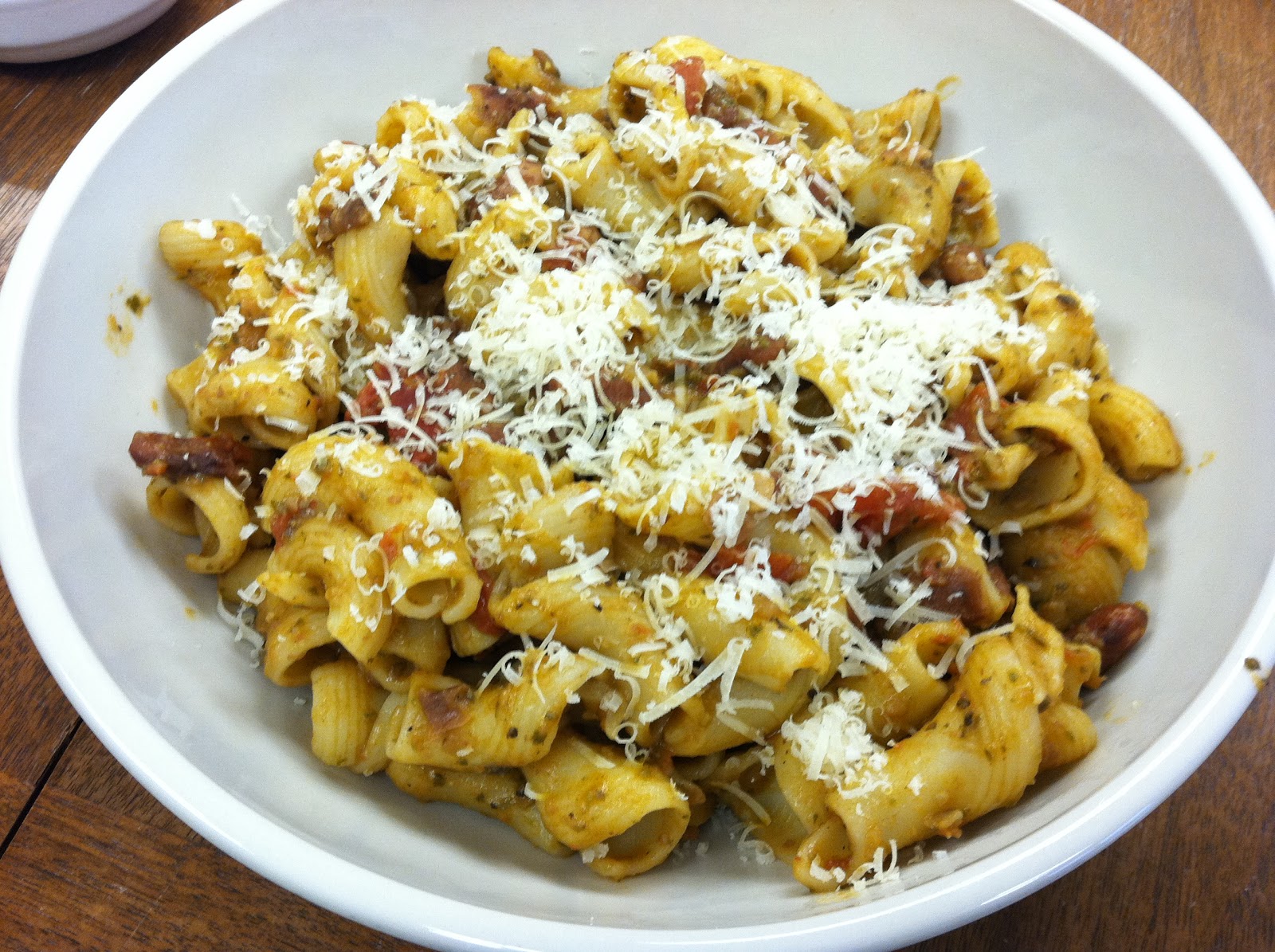
Pasta and Beans

I have been on this Italian - Mediterranean kick for quite some time.  Frankly, I am fascinated with  the European view of food.  I was also a little skeptical of pasta and beans in one dish.  It just did not sound good to me.  However, I was fascinated enough to pick out the recipe. 

When I really thought about it, Olive Garden makes a pasta e fagioli soup. As it turns out, pasta and bean soup is a traditional Italian dish, made from inexpensive ingredients.  It is traditionally made with cannellini or borlotti beans and some type of small pasta, such as elbow macaroni or ditalini.  Onions, garlic, rosemary or basil are used as seasonings.  Most recipes use tomatoes or tomato sauce.  For a more meaty flavor, prosciutto or pancetta can be used.

I got this recipe from The New Mediterranean Diet Cookbook by Nancy Harmon Jenkins.  A note to this recipe stated that you could make the pasta and beans.  And if there were any leftover, you could add stock and make soup.  Two meals for the price of one, I was 'in'.  I used Jacob's cattle beans.  But you could use pinto, cranberry or a similar light reddish bean.  I also used pesto, about 2 tablespoons, instead of the actual basil.  Pesto was in my frig and basil is too expensive.  Yes, I am cheap.

If you want additional vegetables,  sautéed greens, such as kale or spinach.  Winter squash can also be added to this dish.  If this recipe works out, I'm going to try zucchini.

Day 1.  I made the pasta and beans.  My faithful tasters loved it.

Pasta with Pancetta and Beans

Serves 8 to 10.

Ingredients:

1 cup dried beans, such as borlotti, cranberry, or pink
¼ cup extra-virgin olive oil, divided
1 medium yellow onion
2 large garlic cloves, minced
3 to 4 ounces pancetta, diced
1 can (14 ounce) whole plum tomatoes
salt and freshly ground black pepper
1 pound short pasta, such as farfalle or bowties
¼ cup sliced basil leaves
Freshly grated Parmigiano reggiano

Directions:

1.  Sort, wash and soak the beans.  Drain.  Transfer to a saucepan, cover with water to a depth of about 1 inch above the beans.  Cover and cook until beans are tender, about 30 minutes to 1 hour.  Set aside, reserving one cup of the cooking liquid.

2.  Chop the onion and set aside.  Add 2 tablespoons of the olive oil to a large heavy pan.  Set over medium-high heat.  Add onion and cook until onion is translucent.  Add garlic and pancetta, continue cooking for about 10 minutes, or until the garlic is soft and the pancetta has started to release its fat.

3.  Add tomatoes, breaking them up with the side of a spoon.  Cook, continuing to break up the tomatoes, until they have reduced to a sauce.  Taste and add salt and pepper.  Add beans the cooking liquid.  Return to a simmer and cook for about 10 minutes, to make a thick sauce. 

4.  In a separate saucepan bring about 5 quarts of salted water to a rolling boil.  Add pasta and cook rapidly until the pasta is almost, but not quite, ready to eat.  Drain and quickly add the pasta to the bean sauce, toss to mix well.  Sprinkle with basil or add pesto.  Drizzle with olive oil and top with cheese.

Note: If desired,beans can be made and frozen in individual containers.  Pasta can be added when ready to eat.


Day 2.  Pasta e fagioli.  I added broth and made soup.  My tasters liked it as well.

Thursday, February 7, 2013

Soul Food Junkies

Recently public television aired the documentary Soul Food Junkies.  It was an excellent documentary and very nicely done.  I applaude the producer Bryon Hurt and public televison for tackling this sensitive and diverse subject.  African Americans hold soul food close to their hearts.  Even if we no longer consume soul food on a regular basis, it is still a part of our culture.  Soul food is also very diverse, with everything from collard greens to gumbo.  And no, we don't fry everything we eat.

The soul food diet encompasses lots of healthy foods, such as black-eyed peas, pinto beans, sweet potatoes, watermelon, collard greens, turnips, cabbage.  The 2010 Dietary Guidelines for Americans recommends that we consume these foods.  They are good sources of fiber and beta-carotene.  Collards, turnips and cabbage are member of the brassica family of vegetables.  Research suggests that consumption of these vegetables may reduce risk of certain forms of cancer. 

While the soul food diet is not all bad, it can be high in sodium and fat.  And those things need to change.  But let's don't toss out the baby with the wash water. 

The website for Soul Food Junkies has a 'Pin It to Win It' section.  You can go on the website and find healthier soul food recipes and you can also pin your masterpiece.

I am posting my new 'classic', Black-eyed Pea Salad with Sriracha Vinaigrette.  It's a twist on black-eyed peas. 

Black-eyed Pea Salad with Sriracha Vinaigrette

Serves 6.

Ingredients:

2½ Tablespoons white wine or apple cider vinegar
2 Tablespoons extra virgin olive oil
1 to 1½ Tablespoons Sriracha sauce
½ teaspoon salt
1 bag (16 ounce) frozen black-eyed peas
3 celery ribs
2 carrots
1 red or yellow bell pepper
1 cup lean ham, about 4 ounces
cup chopped parsley

Directions:

1.  In a small bowl, combine vinegar, olive oil, Sriracha sauce, and salt.  Set aside.
2.  Cook black-eyed peas according to package directions.  Drain.  Rinse in tap water.  Drain and set aside. 
3.  Chop the celery.  Peel and grate the carrots.  Chop the bell pepper and ham.  Combine in a large bowl.  Add black-eyed peas and parsley.  Stir to combine.
4.  Add vinaigrette and stir.  Allow salad to sit for at least 10 minutes or up to one day before serving.

Source:  Whole Foods Market


Wednesday, January 9, 2013

Food Trends of 2013

I just love food trends. I am not sure why.  Maybe it's the foodie/wanna be statistician in me.  But they are just plain fun.  So, of course I had to find out what the top food trends were for 2013.  I checked out several sources, 'cause that's what us science folks do.  Food Network had Eight Top Food Trends of 2013.   It sounds like they got tired and just could not get to ten.  Maybe I'm a bit cynical, but I feel a little shortchanged with only eight.  Epicurious.com  had thirteen categories and each is divided into front burner and back burner segments.  Wonder if they had more people at the table, umh!

According to one resource, kale is out.  I'm all for eating kale, but kale chips?  Not so sure about those.  One resource had cauliflower rising to the top.  Still in the cruciferous family.  In 2011, sweet potatoes were the new 'in' food.  While I am not sure about the accuracy of these lists, I am very happy to see vegetables making the top of the list.  It feels like vegetables are finally getting their due respect.

In keeping with this 'trend thing' and my recent trip to Sicily, I'm cooking a dish with pasta and cauliflower.  Americans seem to believe that pasta dishes must be drowned in sauces, especially tomato sauce.  But Italian pasta dishes are so much more than pasta and sauces.  Italians make very good use of vegetables. 

For this dish, I am using Lidia Bastianich's book, Lidia Cooks from the Heart of Italy.  I did adapt the recipe somewhat.  I did not have fresh cavatelli pasta.  I used dried campanelle pasta and cooked the pasta and cauliflower in the same water. 

Pasta with Cauliflower

Serves 6.

Ingredients:
½ teaspoon Kosher salt, plus more for pasta pot
1 large head cauliflower, cut into small florets
1 pound dried pasta
½ cup extra virgin olive oil
7 large garlic cloves, peeled and sliced
½ teaspoon red pepper flakes, or to taste
2 Tablespoons chopped flat leaf parsley
1 cup freshly grated Parmesan cheese

Directions:
1.  Fill a large pot with water and about 1 tablespoon salt.  Heat to boiling. 

2.  Add cauliflower and cook for about 1 minute.  Add pasta and continue to cook until pasta is al dente, about 5 minutes.

3.  Preheat a large skillet.  Pour in the olive oil.  Toss in the sliced garlic.  Add red pepper flakes and parsley; stir and cook for about one minute.  Add about ½ cup of the pasta water.  Reduce heat and simmer until ready to add the pasta. 

4.  Drain pasta and cauliflower.  Add to skillet.  Toss pasta and cauliflower until they are coated with the sauce.

5.   Turn off the heat.  Add the cheese and toss again.  Heap the pasta into warm bowls.  Sprinkle with additional cheese, if desired.

Wednesday, August 8, 2012

Clafoutis Anyone?

A few days ago, a colleague and I were discussing recipes for another project that I am working on.  She suggested that I might do a clafouti recipe.  I decided that it might not be a good choice for the other project, but it might be a good blog topic.  After all, it is a French dessert and we (or rather PBS) are celebrating the 100th anniversary of Julia Child's birth.


I must admit that I do not have any fun childhood memories of Julia Child.  My mother and I did not cook her recipes together.  However, with my job of helping people develop food preparation skills, I have come to admire and respect Julia Child.  She had great love of food and inspired Americans to become better cooks.  While Julia may have used her share of butter, she died 2 days before her 92nd birthday and was not overweight.  As Julia used to say, 'all things in moderation, including moderation'.  While I am all for healthy eating, I am also for good eating and I do not not believe these are mutually exclusive terms.  It is with that in mind that I am writing about clafouti and Julia Child.

Clafouti also makes excellent use of summer fruits, such as peaches, plums, and cherries.  I've even seen recipes with raspberries, apples and pears.  I've had my student make it with pears and did not care for it.  It needed a fruit with more intense flavor.  However, if you have nice, flavorful pears, why not give it a try. 

Apparently, the clafouti is a French country dessert from the Loire region of France.  I think of it as fruit baked in a custard. It was originally made with cherries.  I also understand that the pits add extra flavor.  I can't say that I have ever left the pits in.  I'm just not that brave.

I have seen tons of recipes for clafouti, with varying levels of milkfat.  Because I like a soft custard, I decided to use a combination of half and half and whole milk.  To satisfy more of my 'foodie' colleagues, I made half plums and half peaches.  This is my version of clafouti. 

Clafouti

Serves 6 to 8.

Ingredients:
¼ cup, plus 1 Tablespoon sugar
¾ pound fruit, such as peaches, plums or cherries
¾ cup whole milk
¾ cup half and half
¾ cup all purpose flour
3 eggs
¼ teaspoon salt
1 teaspoon vanilla
2 Tablespoon almond liqueur, optional

Directions:
1.  Preheat oven to 350°F.  Butter a pie plate.  Sprinkle with one tablespoon sugar. 
2.  Slice fruit.  Place over sugar in a pleasing design.
3.  In a blender, blend milk, half and half, flour, eggs and salt.  Blend until smooth.  Add the one-fourth cup of sugar, vanilla and almond liqueur.  Pour over fruit.  Bake at 350°F for about 30 minutes or until puffed and golden.
4.  Dust clafouti with powdered sugar and serve at once.

Normally, I would not use liqueur, however since we are celebrating Julia Child, I felt a little alcohol would be appropriate.  If you are celebrating Julia Child, let us know what you are doing.

Tuesday, July 31, 2012

Crostinis, Crostinis, Crostinis!


Up until a couple of years ago I had never heard of crostinis.  And now they are everywhere.  It seems that any and everything is a crostini, such as eggplants, tomatoes, sardines. 

According to The Prentice Hall Dictionary of Culinary Arts, crostini is Italian for 'little toasts' and is used to describe small, thin slices of toasted bread, usually brushed with olive oil.  Who knew!

Sicily was overflowing with crostinis.  And why not?  If you have leftover bread, why not use it to make something edible - think bread pudding.  For centuries clever cooks have turned the 'not so edible' into the 'this is delicious'. 

One crostini that we consumed while in Sicily was made with eggplants and chopped tomatoes.  Both of these plants grow extremely well in the Mediterranean.  And cooks make good use of them. 


Here is my version of Crostinis with Aubergine Tapenade.  I hope you enjoy them.  Some countries refer to eggplants as aubergines.

Crostinis with Aubergine Tapenade

Ingredients:
1 medium eggplant
1 garlic clove, minced
1 teaspoon dried oregano
Salt and pepper, to taste
3 Roma tomatoes
Day old baguette

Directions:
1.  Preheat oven to 350°F.  With a sharp knife, pierce eggplant in several places.  Place on a rimmed baking sheet and bake until soft, about 1 hour. 

2.  Allow eggplant to cool.  Remove the skin and stem.  Cut eggplant into small pieces.  Add garlic, oregano, salt and pepper.  Set aside.

3.  Thinly slice the bread, on the diagonal, into
about ½-inch thick slices.  Brush with olive oil and place on a sheet pan.  Place in the oven at 350°F, until they are crisp, about 15 minutes. 

4.  Dice the tomatoes into small pieces, about ¼ inch.  Combine with eggplant mixture. 

5.  At this point, you can top the bread with the eggplant tapenade or set them out separately and allow your guest to top the bread as they desire.

As to which one I would do, it depends on how much time I have.


Wednesday, July 25, 2012

Eating Potatoes in Sicily

While in Sicily, we had the pleasure of attending the Cucina del Sole Cooking School.  The school is headed up by Eleonora Consoli, a gastronomy journalist. Needless to say, we had a good time.  Put 20+ foodies in the room together (with food, of course) and they have a good time.


It was really a lot of fun learning about Sicilian cuisine.  It's always fun to expand your cooking repertoire.  I came back with a few good recipes that could easily find their way into my own cooking. 

One of the first dishes we made in Sicily was a potato and pistachio casserole.  As it turns out, Sicily grows pistachios.  So they make good use of them in their cuisine.  Most pistachios are grown around the Mount Etna and Bronte areas.  Most pistachios grown in Sicily are consumed in Sicily.  Very little is exported.  Although widely viewed as a snack food, pistachios are well-suited for many recipes requiring nuts.  The next time you have a recipe calling for pine nuts, give pistachios a try and see how you like them.

Potato and Pistachio Casserole

Serves 4.

Ingredients:
1½ pounds baking potatoes, such as Russet or Yukon Gold
2/3 cup grated Parmesan cheese
2 Tablespoons butter, plus additonal for coating the dish
Pinch of nutmeg
Salt and pepper, to taste
2 large eggs
½ cup pistachios, finely chopped, divided

Directions:
1.  Peel  and coarsely chop the potatoes.  Place in a medium saucepan and cover with water.  Cook until potatoes can be easily pierced with a fork.  Drain.  Place on heat to dry potatoes.  There should be a film on the bottom of the pan. 

2.  Mash potatoes.  Add cheese and butter, nutmeg, salt, and pepper.  Stir to combine.  Add eggs once potatoes are cool enough.

3.  Coat a casserole dish with butter.  Add pistachios and coat the dish.  Pour out extra pistachios and reserve for topping.

4.  Place potato mixture in casserole. Top with pistachios.  Bake at 350°F for about 30 to 40 minutes.

According to Ms. Consoli, one can put other ingredients in the middle of this casserole. Some of her suggestions were artichokes, spinach, asparagus, eggplant, zucchini, cheese, mushrooms, and hard boiled eggs.  For my version, I added grated zucchini in the middle of the casserole.


Tuesday, July 17, 2012

Simplicity

Oftentimes, I struggle to get my students to understand that there is nothing wrong with simplicity.  Simplicity can be a beautiful thing.  That is no more true than with fresh summer produce.  Good, fresh food needs little adornment. Sometimes all you need to do is wash, cut and eat.  To borrow a phrase from Ina Garten, "How easy is that".

When I think of simplicity and summer foods, I think of a tomato sandwich.  Yes, a tomato sandwich.  This must be a Southern thing, because my Midwestern friends look at me like I'm nuts.  If the idea of a tomato sandwich seems a little odd to you, think of it as a BLT without the B and the L.

Here is how you get started with a tomato sandwich.  First of all, you need good quality bread. You need a sturdy bread to soak up all those tomato juices.  I used challah.  You also need good tomatoes.  This is when you get out of bed in time to hit your local farmers market or your garden.  I like mayonnaise on mine, maybe with the addition of garlic.  If you really want to get fancy, top it with a little of your favorite cheese, such as Parmesan, sharp cheddar, or a fresh goat cheese.  You can also add chopped basil, capers or a drizzle of balsamic vinegar.  Those additions sound really great.  But I am going to stick with my simple version.


Tuesday, July 10, 2012

Food from Sicily

Recently, I told you that I would share some recipes from Sicily with you.  Here is the first of those recipes - Panelle or chickpea fritters.  Before traveling to Sicily, I had never heard of panelle or chickpea fritters.  We had them on at three different occasions over the course of 14 days.  They were served mostly as an appetizer or snack.

Since returning to the states, I have learned that panelle is served as a sandwich, Pane e Panelle.  It is especially popular in Palermo, Sicily.  My understanding is that panelle is found in Sicily due toArab influence.  The Arabs ruled Sicily at one time.

Basically, panelle is chickpea flour, water, salt and sometimes, herbs such as parsley.  This mixture is cooked to hydrate the beans.  It is then spread onto a flat surface, allowed to cool and cut into serving size pieces.

Here is my version of panelle.

Panelle (Chickpea Fritters)

Serves 4.

Ingredients:
1¼ cups chickpea flour
3 cups water
1 teaspoon salt
¼ cup chopped parsley

Directions:
1.  Combine chickpea flour, water, and salt.  Cook over medium heat, stirring constantly.  Add parsley when mixture begins to thicken.  When mixture has absorbed all the water and is pulling away from the side of pan, quickly spread onto a jelly roll pan or cookie  sheet.  Cover with plastic and allow to cool.

2.  Preheat oil to 375°F.  Cut panelle into 1 X 2-inch strips.  Drop several into oil and fry until golden brown.  Drain on a paper towel lined cooling rack.  Serve immediately.

Note:  The chickpea flour mixture can be cooked through the first step and refrigerated for one day.

Monday, July 2, 2012

Bacon and Farmers Market


I have not made it to my local farmer's market this year.  Normally, I am regular by this time.  Before you feel too sorry for me, I missed several opportunities to go to the market due to a trip to Sicily.  Ok, your sympathy for me has hit a new low!


Although Sicily was a lot of fun, I really did miss my local farmer's market.  No matter how many farmer's markets I visit, nothing beats my farmer's market.  So what's so special about my farmer's market?  For everyone else, probably nothing.  For me, it's just a special place. 


Since I have not traveled to the market this year, I have been dreaming about what I could make with my first purchase at the market.    I found a recipe for Warm Bacon Vinaigrette in the April issue of Cooking Light.  I thought it would be a perfect dressing for fresh farmer's market vegetables.  I made the vinaigrette and used it on potatoes and greens beans.  They were pretty good, even if I must say so myself.


Thursday, June 28, 2012

Celebrating All the Colors of America


Every year around July4th, a slew of red, white and blue recipes appear on numerous websites.  You can find recipes for red, white and blue jello, cakes, and just about every other dessert. 

When I think of America, yes, I think of red, white and blue.  I also think of all the other colors of this country.  We are a nation of immigrants, coming to this country in search of our own American dream.  Some came by choice, while others came by force.  But be that as it may, we are all Americans.  So this July 4th, let's embrace all that we are.

In honor of July 4th, I am posting a blog by one of my students, Adrijana Pusnik, a new immigrant from Croatia.  So here is the blog, in Adrijana's own words.


Being from the Balkans and now residing in the Midwest, I have to share my Balkan cuisine with my American friends.  None is more popular back home than ćevapi (or chevapi).  These are mini finger like sausages that are grilled and served on pita bread with onions and other condiments.

The origin of ćevapi has many different variations, but the story that I am familiar with goes that this recipe was founded on the Ottoman Empire expansion into the Balkans where the Slavs, who lived there, had to obey the Ottomans or they would be killed.  One of these ways to obey was to adapt to their cuisine, such as the kebab or a larger version of ćevapi consisting of a larger grilled sausage served on pita bread.

There are a few things I like about the recipe, such as it is a reasonable portion size and perfect for social gatherings.  As well as, it doesn't take long to make and there is flexibility with ingredients being added to create one's own version of ćevapi.  The total cooking time is about 30 minutes, usually about 10 minutes to prepare the mixture and about 20 minutes to grill. 

Ćevapi (or Chevapi)


Serves 4.

Ingredients:


1 pound ground beef, pork and/or lamb
1 egg white
1 to 4 garlic cloves or ¼ cup chopped onion
1 teaspoon salt
1 teaspoon baking soda, to tenderize the meat
1 to 2 teaspoons ground black pepper
1 teaspoon cayenne pepper
½ teaspoon paprika


Directions:

1.  Preheat a grill for medium-low heat.

2.  In a large bowl, combine the meat and egg white.  Add garlic or onion, salt, baking soda, black pepper, cayenne pepper and paprika.  Mix well.  Form into finger length sausages, about ¾ inch thick. 

3.  Lightly oil the grilling surface.  Grill sausages until cooked through, turning as needed, about 10 minutes for each sausage.

4.  Ćevapi are usually served on pita bread with condiments of one's choice, such as grilled onions and ajvar.


Tuesday, June 12, 2012

Eating Sicily

Sorry about not posting recently, but I was eating my way around Sicily.  We arrived in Catania, Sicily on May 20th and departed on June 2nd.  We had a wonderful trip.  To all the Sicilians who shared their culture with us, thanks.  I hope when you to travel to the US, we will show you the same hospitality. 

Over the summer, I will be sharing some of my favorite Sicilian recipes on this blog.  I had some very good and memorable foods. 


I must say Sicily had the most beautiful and biggest garlic bulbs I have ever seen.  If only I could have brought a few back to the states.


Eggplants, well, I think Sicilians have mastered using eggplants.  We saw variety after variety of eggplants.  We had eggplant lasagna, eggplant roll-ups, ricotta cheese sandwiched between eggplant slices.


Veal Involtini - essentially this is meat rolled around breadcrumbs and either fried, baked or grilled.  These were very thin slices of veal.  This dish makes good use of breadcrumbs and a small amount of meat.


And, finally dessert.  Most desserts tended to be lighter and refreshing. 

If you've got a favorite Mediterranean recipe, let us know.  But check back over the summer and see what is happening as a result of my trip. 

Tuesday, May 1, 2012

Reese's Tater Tot Casserole

For a long time, no one seemed to cook.  I knew people who even bragged about how they could not cook.  We were proud of our inability to prepare a few simple dishes.  Then along came Martha Stewart and Food Network.  And all of a sudden, cooking was back in vogue.  Thank God! 

Somewhere along the way we seem to have forgotten about the shear joy of sharing a meal with people we care about.  A lifetime of memories are made in the kitchen and at the table.  Sharing a meal is often where we learn the art of conversation and manners.  It is where we pass on values and traditions. 

Cooking may seem frivolous in a time-crunched society, but cooking stimulates creativity.  The late Julia Child believed that food is more than sustenance and children must be taught that cooking is akin to art.  Cooking is as creative as music, drawing.  Cooking helps children learn to love food - children should experience food hands on.  Research shows that hands-on cooking is a great way to improve mealtime practices and eating habits of children.  They need to taste, to touch, smell and listen to food. 

But enough with all the soft, feel good and scientific stuff, cooking and eating are just plain fun. 

Tater Tot Casserole is a favorite of a colleague's daughter.  Her favorite thing about this casserole is lining up the tater tots exactly the same.  Her mother says that even though the recipe states to dump it all together, it actually cooks better when the tater tots are "lined up". 

Tater Tot Casserole

Serves 8 to 10.

Ingredients:

1 package (32 ounce) tater tots, thawed
2 cups (8 ounces) American or Cheddar cheese, shredded
1 can (10¾ ounce) condensed cream of chicken soup
1 cup sour cream
½ cup onion, finely chopped
¼ cup butter, melted
½ teaspoon black pepper
1 cup corn flakes, crushed
1 Tablespoon butter, melted
Cooking spray

Directions:

1.  Coat a 9 X 13-baking dish with cooking spray.  Place tater tots in baking dish; set aside. 
2.  In a large mixing bowl, combine cheese soup, sour cream, onion, butter, and pepper.  Pour over tater tots.  (If desired, casserole can be assembled up to this point and refrigerated.)
3.  Toss together cornflakes and one tablespoon of butter.  Sprinkle over casserole.  Bake in a 350F oven for about 1 hour or until casserole is golden brown.

To make this dish a little healthier, use reduced fat cheese and sour cream.