Wednesday, April 17, 2013

National Garden Month

April is National Garden Month and time to 'gear up' for the growing season.  Americans are gardening in greater numbers than ever.  In 1971, 25 million households or 39% of American families raised a portion of their vegetables.  According to a recent report, 49% of Americans gardened in the past 12 months. 

Most Americans (30%) garden for access to fresh vegetables and second (25%) most popular reason for gardening is better-tasting, higher quality food.  Gardening for fun (22%) beat saving money (15%) as a reason for gardening. 

The most popular vegetable for the home gardener is by far, the tomato.  It is followed by, in order, peppers, green beans, cucumbers, onions, lettuce, summer squash, carrots, radishes and in tenth place, sweet corn. 

If you would like to begin gardening this year, check out your local county extension office.  Gardening centers also offer a wealth of information, as do seed companies. 

In honor of National Garden Month, I am pulling out something from last year's garden - winter squash.  After all, gardeners can not throw anything away. 


Spiced Butternut Squash Puree

Serves 6.

Ingredients:

1 large butternut squash, about 3 to 4 pounds
¼ cup butter
⅓ cup brown sugar
½ teaspoon freshly grated nutmeg
½ teaspoon salt
½ teaspoon black pepper


Directions:

1.  Preheat oven to 350°F.  Pierce squash with a knife or fork.  Place on a baking sheet and bake for about one hour.  If squash is soft enough, cut in half to allow steam to escape.  Continue cooking until squash can be easily pierced with a knife or fork.


2. Scrape seeds from cavity.  Remove squash from the skin.  Mash squash and add butter, brown sugar, and seasonings.  Taste and adjust seasonings as desired. 


Thursday, April 11, 2013

A Little Short on Cash

Tax time is almost over.  For me, it was over a few weeks ago.  And things did not go my way - I think the government kept too much of my money.  At least in my humble opinion. 

Well, I gotta eat and being the foodie that I am, I want good food.  I am not one for believing that good food has to be expensive.  I prefer not to think of it as cheap, just frugal.  You make the best of what you have.

For my frugal dish, I went back to something my mother used to make, salmon cakes.  This is one of the most inexpensive dishes you can make.  You need a can of salmon, one egg, and some type of bread to bind it.  Crackers and dry bread crumbs work well for this.  Additional seasonings can be added, like onions, lemon zest,  red pepper, and mustard.  Mix it up to suit your tastes.

Recently, I read where a chef stated that canned salmon was like cat food.  "Meow".  Sorry chef, mom used canned salmon and that's what I use.   Canned salmon is great.  It is inexpensive, a good source of omega-3 fatty acids and if you consume the bones, a good source of calcium.  Here is my recipe for salmon cakes.  Use the recipe as a guideline.  If you want to add or remove something, please do so.

Salmon Cakes with Mustard Sauce

Serves 4.

Ingredients:

1 can (14.5 ounce) salmon
¼ cup dry bread crumbs
⅓ cup chopped red onions
1 Tablespoon Dijon mustard
1 large egg
Vegetable oil, for frying

Mustard Sauce:
1 container (6 ounce) plain yogurt
1 Tablespoon coarse grain or Dijon mustard

Directions:

1.  Drain salmon and mash with a fork.  Add the remaining ingredients and mix thoroughly.  Divide into fourths.  Form into a ball and flatten to about ½ inch.

2.  Heat oil in a large skillet over medium-high heat.  Cook salmon cakes, turning once, until golden brown and just cooked through, 6 to 7 minutes.

3.  Stir together yogurt and mustard.  Serve with salmon cakes.

Wednesday, April 3, 2013

National Soybean Month

April is National Soy Foods Month.  Before you turn up your nose, soy foods have come a long way in the United States.  Gone are the days when we associated soy with poor quality, filler ingredients.  It's the real thang!  And for good reason, soy is a very nutritious food.

If you want to consume soy, edamame is a good place to start.  Edamame are harvested at the green stage and can be purchased in the pod or shelled.  They can be used to make salads, humus, added to soups and stir fries. 

A one-half cup serving of edamame contains 3 grams of fat (primarily mono- and polyunsaturated), 8 grams protein, and 4 grams of fiber.  If you are looking for ways to add soy to your diet, try edamame with mustard vinaigrette and check out Cooking Light Magazine website for more recipes.

Edamame with Mustard Vinaigrette

Serves 4 to 6.

Vinaigrette:
2 Tablespoons red wine vinegar
1 Tablespoon Dijon mustard
½ teaspoon salt
2 Tablespoons extra virgin olive oil

Salad:
1 bag (12 ounce) frozen shelled edamame
⅓ cup chopped red onion
½ cup chopped celery
1 Tablespoon minced parsley

Directions:
1.  Vinaigrette.  In a small bowl combine vinegar, mustard, and salt.  Add oil and stir to combine.

2. Salad.  Add about 1 teaspoon salt to about 4 cups of water and bring to a boil.  Add edamame and cook for about 5 minutes.  Drain well.

3.  Combine edamame, onion, celery, and parsley.  Stir to combine.  Add vinaigrette and stir to coat vegetables.  Cover and chill for 1 hour before serving.

Wednesday, March 27, 2013

Asparagus - A Sign of Spring

I'm not sure that seeing asparagus in the grocery store is a true sign of spring.  Since now, I seem to see it all year round.  For me, seeing fresh asparagus means that spring is not far away. 

Since Easter is coming up in a couple of days, I thought this asparagus recipe would be great for a nice dinner.  This is a recipe I made several years ago.  It was originally published in Cooking Light magazine.  A colleague made it and declared that her family gobbled them straight off the baking sheet.  What more can you say about a vegetable!

For more information on selecting, storing and the nutritional value of asparagus check out the Fruit and Vegetables More Matters website.  Also check out the Local Foods/Seasonal Eating section of UNL-Extension Food Website.  You will find more recipes for asparagus and other seasonal produce.

Roasted Asparagus with Balsamic Browned Butter

Serves 8.

Ingredients:

2 pounds asparagus spears, trimmed
1 Tablespoon olive oil
¼ teaspoon kosher salt
⅛ teaspoon freshly ground black pepper
2 Tablespoons butter
2 teaspoons low sodium soy sauce
1 teaspoon balsamic vinegar
Cracked black pepper, optional

Directions:

1.  Preheat oven to 400°F. 
 
2.  Arrange asparagus in a single layer on a baking sheet.  Coat with olive oil.  Rub asparagus to coat with olive oil.  Bake for about 10 to 12 minutes or until tender.

3.  Melt butter in a small skillet over medium heat.  Cook for about 3 minutes or until lightly browned, shaking pan continually.  Remove from heat and stir in soy sauce and balsamic vinegar.  Pour over asparagu, tossing to coat.  Garnish with cracked pepper, if desired.


Thursday, March 21, 2013

Eat Right, Your Way, Every Day

Eat Right, Your Way, Every Day is the tagline for National Nutrition Month.  I'm sure the only people excited about this 'holiday' are those working in the nutrition field.  But, this is an excellent opportunity to talk with consumers about what a healthy diet can be and most of all, how delicious a healthy diet can be.  Just because a food is healthy does not mean it has to taste badly.  Delicious and Healthy can coexist in the same dish. (Sounds like a Disney movie, but that's another story.)

The essence of Eat Right, Your Way, Every Day is that there is no one way to 'eat right'.  When exploring the 'right diet' for you, consider balance, moderation, variety of foods and aiming for a healthy lifestyle.  For more information on diets, check out the Academy of Nutrition and Dietetics website.

If you plan to include fish in your diet, this recipe for baked fish with savory bread crumbs is an excellent place to start.  I came across this recipe in an Italian cookbook.  I tried it out in my Cooking 101 class and they liked it.  Now I am sharing it with you.  If parsley is not your thing, try basil or a basil pesto.  It will still be delicious.

Baked Fish with Savory Bread Crumbs

Serves 6.

Ingredients:

2 pounds whitefish fillets, such as cod
¾ teaspoon kosher salt
6 Tablespoons extra-virgin olive oil, divided
Juice of one large lemon, about 3 Tablespoons
½ cup dry white wine
6 large garlic cloves, crushed and peeled
½ cup fine dry bread crumbs
Zest of a large lemon, about 2 teaspoons
1 Tablespoon chopped fresh Italian parsley
½ teaspoon dried oregano
½ teaspoon crushed red pepper flakes
1 Tablespoon butter, optional
Fresh lemon slices, for serving

Directions:

1.  Preheat oven to 400°F.

2.  Lightly salt fish on both sides.  Pour 3 tablespoons of the olive oil, lemon juice, white wine and ¼ teaspoon salt into the baking dish, and whisk together well.  Drop in the garlic cloves, and stir with the dressing.  Lay the fillets in the dish, turn to coat both sides of fish with dressing.  If your fish has skin, place the skin side down.

3.  Toss the bread crumbs in a bowl with the lemon zest, parsley, oregano, red pepper flakes, and ¼ teaspoon salt.  Add the remaining 3 tablespoons olive oil.  Stir  until the mixture is coated with olive oil.

4.  Spoon the bread crumbs on top of the fish.  Bake, uncovered, until the crumbs are crisp and golden and the fish is cooked through, about 15 to 20 minutes.

5.  Lift the fish out with a spatula, and set on a warm platter to serve family style. 

6.  If desired, reduce the sauce by about one-half.  Add one tablespoon butter, about one-third at a time.  Shake the pan to incorporate the butter.  Pour the sauce over fish and serve.

Wednesday, March 6, 2013

Vegetarian Soul Food...You Kidding?

Vegetarian and Soul Food?  Now is that an oxymoron or what?  I just could not believe it.  Now I can see vegetables as a central part of the soul food diet, but no meat.  I had issues with that. 

While discussing soul food with a colleague, she mentioned the book, Vegan Soul Kitchen by Bryant Terry.  I had heard of the book, but did not pay a lot of attention to it.  After all, vegan and soul food do not go together, at least not in my mind.  I always tell my students to keep an open mind and try new things.  Be careful of what you tell students.

I decided to give this book a try.  I was skeptical, very skeptical.  Upon examining the book, I found a few recipes that sounded interesting.  One was Citrus Collards with Raisins Redux.  My colleague assured me this was a good recipe.  Since she has good taste, I decided to try this recipe first. If she was wrong, I basically would loose a little time and some good collard greens would be lost. 

To say that I was surprised at how good these collards tasted, is an understatement.  They knocked my socks off.  They are a touch sweet, with none of the bitterness typically found in brassica vegetables.  I used freshly squeezed orange juice.  I think you need freshly squeezed with this recipe.
This recipe most definitely will be made again at my house. 

Citrus Collards with Raisins Redux

Serves 4 to 6.

Ingredients:

Coarse sea salt
2 bunches collard greens
2 Tablespoon extra-virgin olive oil
2 cloves garlic, minced
2/3 cup raisins
1/3 cup freshly squeezed orange juice

Directions:

1.  To prepare the collards, start by removing the large rib from the center.  Lay several leaves together.  Roll up and cut into a chiffonade. 

2.  In a large pot over high heat, bring 3 quarts of water to a boil and add one tablespoon salt.  Add the collards and cook, uncovered, for 8 to 10 minutes, until softened.  Meanwhile, prepare a large bowl of ice water to cool the collards.

3.  Remove the collards from the heat, drain, and plunge them into the bowl of cold water to stop cooking and set the color of the greens.  Drain and set aside.

4.  In a large saute pan, combine the olive oil and the garlic and raise the heat to medium.  Saute for one minute.  Add the collards and salt; stir to combine.  Sprinkle raisins on top and cover to allow raisins to soften, about 3 minutes.

5.  Add orange juice and cook for an additional minute or so.  Do not overcook.  Collards should still be bright green.

If you have a favorite soul food recipe that you have altered, we'd like to hear about it.

Wednesday, February 20, 2013

Pasta and Beans

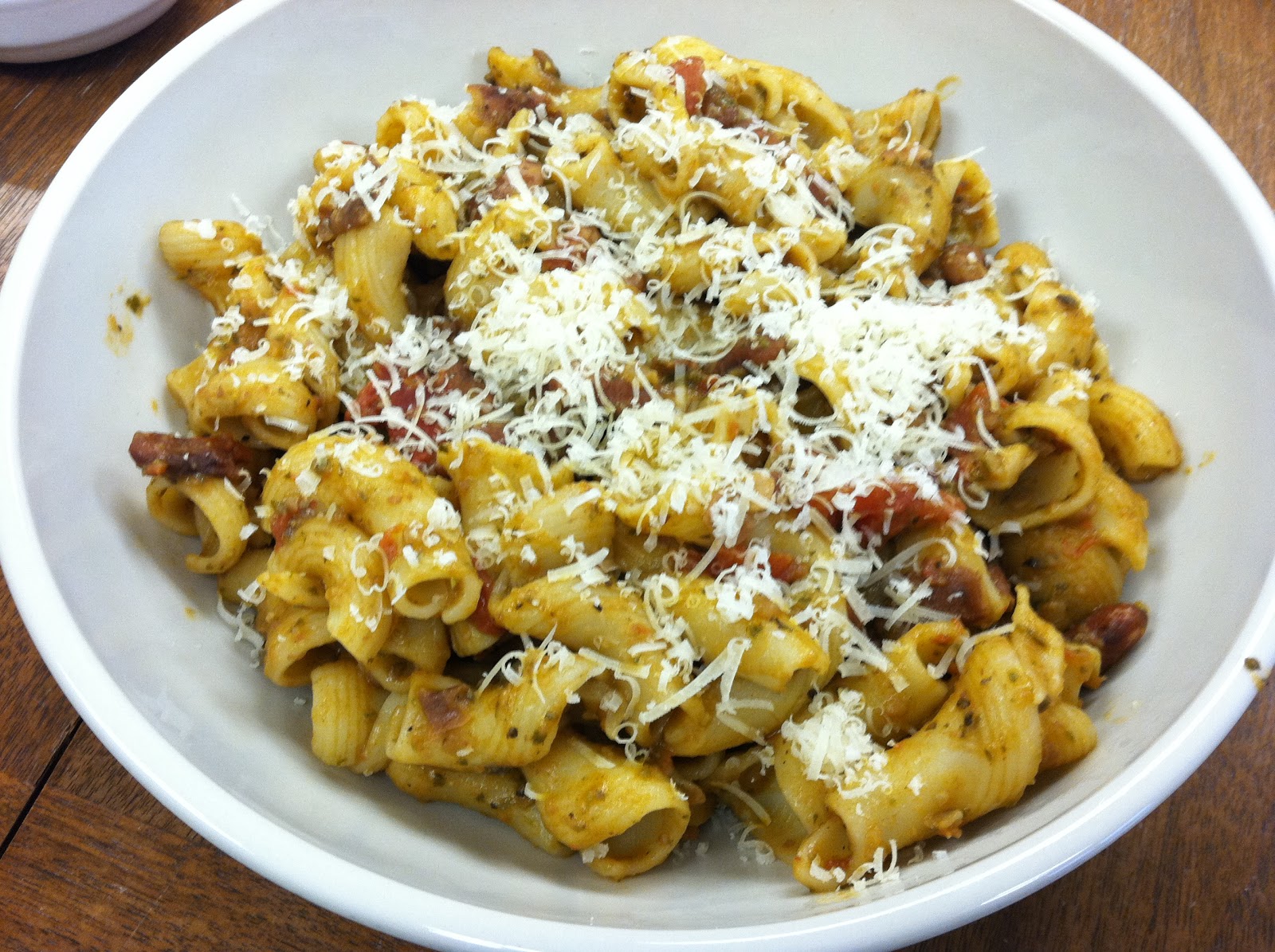
I have been on this Italian - Mediterranean kick for quite some time.  Frankly, I am fascinated with  the European view of food.  I was also a little skeptical of pasta and beans in one dish.  It just did not sound good to me.  However, I was fascinated enough to pick out the recipe. 

When I really thought about it, Olive Garden makes a pasta e fagioli soup. As it turns out, pasta and bean soup is a traditional Italian dish, made from inexpensive ingredients.  It is traditionally made with cannellini or borlotti beans and some type of small pasta, such as elbow macaroni or ditalini.  Onions, garlic, rosemary or basil are used as seasonings.  Most recipes use tomatoes or tomato sauce.  For a more meaty flavor, prosciutto or pancetta can be used.

I got this recipe from The New Mediterranean Diet Cookbook by Nancy Harmon Jenkins.  A note to this recipe stated that you could make the pasta and beans.  And if there were any leftover, you could add stock and make soup.  Two meals for the price of one, I was 'in'.  I used Jacob's cattle beans.  But you could use pinto, cranberry or a similar light reddish bean.  I also used pesto, about 2 tablespoons, instead of the actual basil.  Pesto was in my frig and basil is too expensive.  Yes, I am cheap.

If you want additional vegetables,  sautéed greens, such as kale or spinach.  Winter squash can also be added to this dish.  If this recipe works out, I'm going to try zucchini.

Day 1.  I made the pasta and beans.  My faithful tasters loved it.

Pasta with Pancetta and Beans

Serves 8 to 10.

Ingredients:

1 cup dried beans, such as borlotti, cranberry, or pink
¼ cup extra-virgin olive oil, divided
1 medium yellow onion
2 large garlic cloves, minced
3 to 4 ounces pancetta, diced
1 can (14 ounce) whole plum tomatoes
salt and freshly ground black pepper
1 pound short pasta, such as farfalle or bowties
¼ cup sliced basil leaves
Freshly grated Parmigiano reggiano

Directions:

1.  Sort, wash and soak the beans.  Drain.  Transfer to a saucepan, cover with water to a depth of about 1 inch above the beans.  Cover and cook until beans are tender, about 30 minutes to 1 hour.  Set aside, reserving one cup of the cooking liquid.

2.  Chop the onion and set aside.  Add 2 tablespoons of the olive oil to a large heavy pan.  Set over medium-high heat.  Add onion and cook until onion is translucent.  Add garlic and pancetta, continue cooking for about 10 minutes, or until the garlic is soft and the pancetta has started to release its fat.

3.  Add tomatoes, breaking them up with the side of a spoon.  Cook, continuing to break up the tomatoes, until they have reduced to a sauce.  Taste and add salt and pepper.  Add beans the cooking liquid.  Return to a simmer and cook for about 10 minutes, to make a thick sauce. 

4.  In a separate saucepan bring about 5 quarts of salted water to a rolling boil.  Add pasta and cook rapidly until the pasta is almost, but not quite, ready to eat.  Drain and quickly add the pasta to the bean sauce, toss to mix well.  Sprinkle with basil or add pesto.  Drizzle with olive oil and top with cheese.

Note: If desired,beans can be made and frozen in individual containers.  Pasta can be added when ready to eat.


Day 2.  Pasta e fagioli.  I added broth and made soup.  My tasters liked it as well.